Tel: 972-516-0692

Easy Return Policy
satisfaction guaranteed
satisfaction guaranteed
Premium Products
we guarantee our quality
we guarantee our quality
100% Safe Shopping
256 bit SSL encryption
256 bit SSL encryption
Shop By Category
Shop By Brand
Shop By Brand
Ring Magnets
Straight-Bore Annular NdFeB Stock
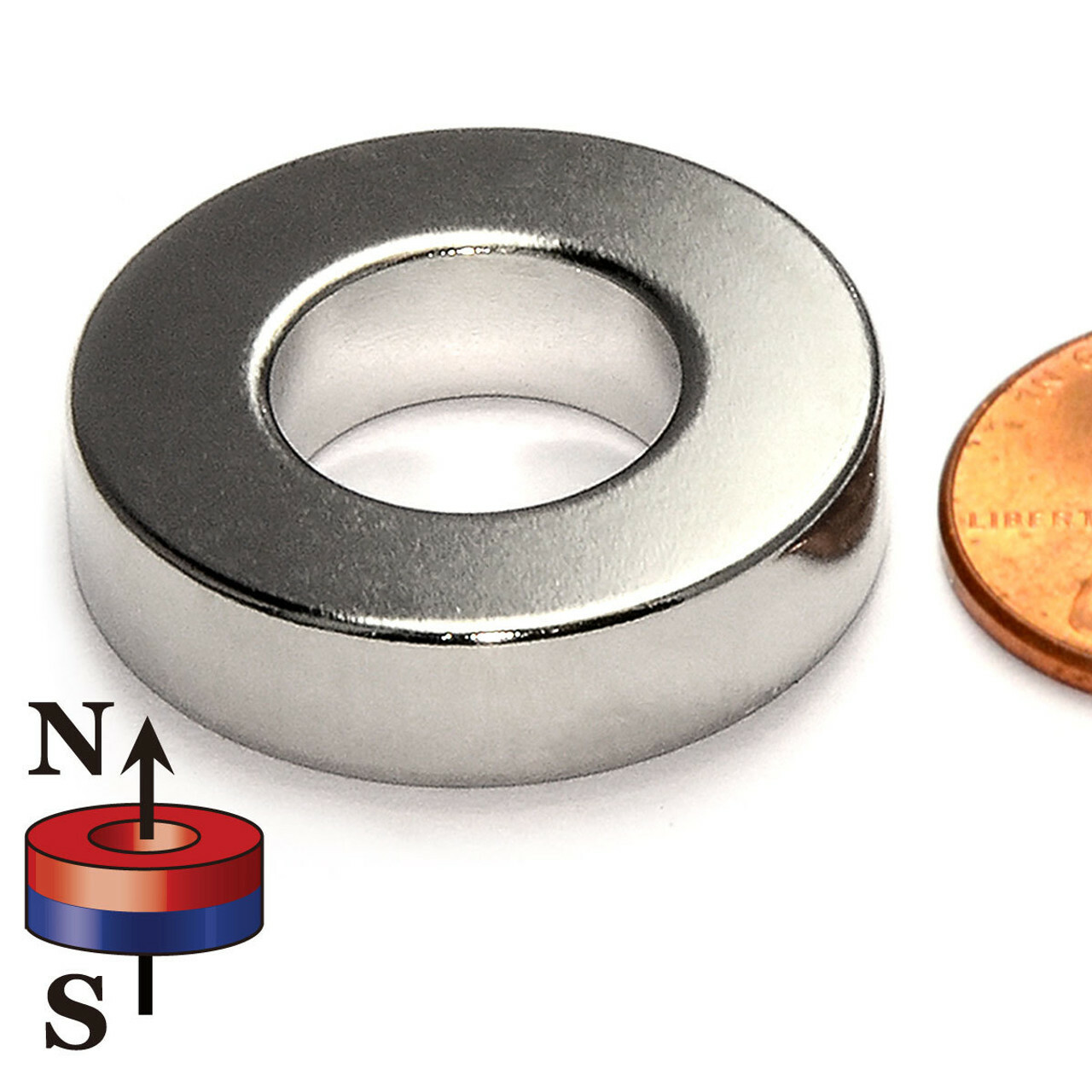
Neodymium Ring Magnets (Center-Hole Annular & Donut Magnets)
CMS Magnetics stocks precision-sintered neodymium ring magnets (NdFeB), also known as annular or hollow donut magnets, engineered for mechanical shaft pass-through, magnetic bearings, loudspeakers, and rotary sensor assemblies. Featuring a uniform straight-bore through-hole (non-countersunk), these circular rings allow non-magnetic brass, stainless steel, or plastic rods, guide pins, and fasteners to pass completely through the magnetic center. Magnetized axially through the thickness (one flat circular face is North, the other South), our ring magnets deliver intense clamping and flux saturation across a broad spectrum of commercial grades from N35 through ultra-high-energy N52, finished in standard triple-layer Ni-Cu-Ni plating.
Looking for screw mounting, solid cores, or specialized poles? For flat-head screws, browse our Countersunk Discs. For solid circular cores without through-holes, view Solid Discs and Cylinder Magnets. For side-to-side poles, view Diametric Magnets, or return to our master Neodymium Magnets catalog to explore rectangular blocks and assemblies.
Straight-Bore Clearance
Uniform inner diameter (ID) throughout the entire thickness for guide rods, pivots, and shafts.
Axially Magnetized
Opposite flat annular faces act as North and South poles, ideal for repelling or attracting stacks.
Precision Ground ID/OD
Concentric inner and outer diameters machined to ±0.05 mm for balanced rotational runout.
Triple Ni-Cu-Ni Barrier
Complete electrolytic nickel-copper-nickel coverage protecting internal bore and outer edges.
Filter Related Shapes & Grades: N52 Ring Magnets Arc & Rotor Wedges Cylinder Magnets Countersunk Discs Solid Disc Magnets
Engineering Guide: Specifying & Integrating Neodymium Ring Magnets
Neodymium ring magnets present a unique toroidal flux distribution that differs substantially from solid discs. Because the central core is hollow, magnetic flux lines are concentrated into the narrow annular wall between the outer diameter (OD) and inner diameter (ID), creating high localized magnetic flux gradients directly above the ring face.
Neodymium Ring Grade Characteristics (N35 to N52)
| Grade | Residual Induction (Br) | Energy Product (BHmax) | Max Operating Temp (Tmax) | Recommended Engineering Use |
|---|---|---|---|---|
| N35 | 11.7 – 12.1 kG | 33 – 36 MGOe | 80°C (176°F) | Standard mechanical damping, guide sleeves, educational kits |
| N42 | 12.8 – 13.2 kG | 40 – 43 MGOe | 80°C (176°F) | Loudspeaker drivers, magnetic couplings, rotary position encoders |
| N48 | 13.8 – 14.2 kG | 46 – 49 MGOe | 70°C – 80°C | Precision medical robotics, high-torque eddy current brakes |
| N52 | 14.3 – 14.8 kG | 50 – 53 MGOe | 65°C – 80°C | Maximum saturation where thin annular wall profiles are constrained |
Ring Magnets vs. Countersunk Discs: Selecting the Right Hole Profile
One of the most frequent specification errors occurs when ordering ring magnets for screw fastening. Understanding the mechanical differences avoids cracked magnets during assembly:
- Ring Magnets (Straight-Bore): Feature a 90° perpendicular cylindrical hole through the center. The diameter is identical on both faces. These are designed for axle pass-through, centering dowels, non-magnetic guide pins, or using flat pan-head screws with nylon washers. They should never be fastened with tapered wood or drywall screws.
- Countersunk Magnets (Beveled Bore): Feature an engineered 82° or 90° chamfer on one face designed to let flat-head screw heads sit completely flush with or slightly below the magnetic surface. If your goal is surface-flush wood or metal mounting, choose our Countersunk Disc Magnets.
- Fastener Material Warning: Always use non-magnetic fasteners (300-series brass, austenitic stainless steel, or nylon) when securing ring magnets. Ferrous carbon-steel screws will distort the external magnetic field and short-circuit flux paths through the fastener.
Designing Magnetic Springs & Levitation Stacks
Because of their straight bore, ring magnets are widely utilized to construct frictionless magnetic shock absorbers and non-contact spring mechanisms:
- Repulsion Alignment: Multiple rings are slid onto a non-magnetic guide rod (such as polished brass, bronze, or Delrin) arranged with like poles facing one another (North-to-North, South-to-South).
- Non-Linear Spring Constant: Unlike mechanical coil springs that follow Hooke's Law linearly ($F = -kx$), magnetic repulsion force increases exponentially as the air gap closes ($\approx 1/r^2$). This delivers high shock dampening without physical bottoming-out shock.
- Guide Rod Sizing: Allow a minimum 0.5 mm to 1.0 mm radial clearance between the ring inner diameter and the central guide rod to prevent binding under lateral mechanical loads.
Frequently Asked Questions
How are ring magnet dimensions specified?
Neodymium ring magnets are universally dimensioned as Outer Diameter (OD) × Inner Diameter (ID) × Thickness (T). For instance, a 1" × 1/4" × 1/8" ring has an outer circular diameter of 1 inch, a center hole diameter of 1/4 inch, and an axial thickness/height of 1/8 inch.
Can I use a tapered/flat-head screw to mount a ring magnet?
No. Tightening a tapered screw into a straight-bore ring magnet applies wedge stress against the brittle sintered NdFeB inner hole, causing the ring to fracture or shatter. Straight-bore rings should only be secured with pan-head screws and resilient washers, or by selecting pre-machined Countersunk Disc Magnets designed specifically for flat-head screws.
Are your ring magnets magnetized through the hole or across the faces?
All stock ring magnets in this category are axially magnetized through the thickness. One flat annular ring face is North, and the opposing flat face is South. The inner bore is not a separate magnetic pole; rather, the flux loops through the central hole between the two flat faces.
How does a ring magnet's pull force compare to a solid disc of the same outer dimensions?
Because the central hole removes active sintered material, a ring magnet will have a slightly lower total pull force against a large flat steel plate compared to a solid disc of identical outer diameter and thickness. However, the flux density ($B_r$) directly at the annular rim is often higher, resulting in a steeper magnetic field gradient over short air gaps.
Join Our Mailing List for special offers!
Discover Magnet4Sale's latest industrial magnets, engineering insights, and exclusive offers. Get updates on advanced solutions and product innovations in our world of high-grade magnets. Subscribe for essential engineering-focused content!