
Channel Magnets
Engineering Guide: Channel Magnets & Heavy-Duty Cabinet Catches
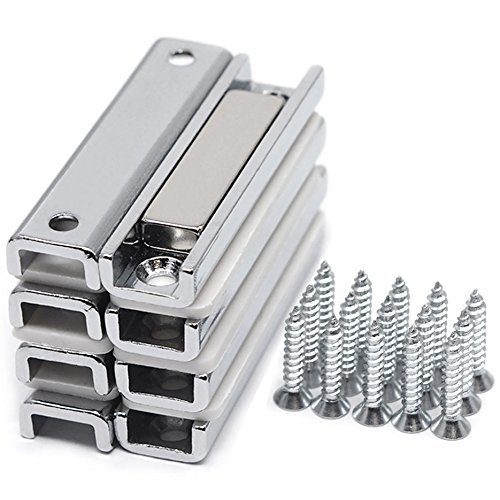
Channel magnets (frequently specified by cabinetmakers and fabricators as cabinet magnets or rectangular magnetic bases) are heavy-duty magnetic assemblies designed for flush attachment to non-magnetic substrates such as natural timber, plywood, plastic composite stiles, and aluminum frames. Consisting of precision-machined, sintered permanent magnet blocks—either rare-earth Neodymium (NdFeB) or ceramic ferrite—seated firmly within a zinc- or nickel-plated steel U-channel, these assemblies replace fragile mechanical plastic ball catches and friction latches that degrade over repeated operating cycles.
The Steel Shunt Effect: Why Channel Assemblies Outperform Bare Magnets
In an unshielded permanent magnet block, magnetic field lines radiate symmetrically in 360 degrees from both north and south poles, leaving half of the total flux energy directed away from the contact face. A channel magnet completely alters this magnetic circuit:
- Magnetic Flux Shunting: The mild steel U-channel acts as a high-permeability magnetic conduit. It collects the flux from the back and side surfaces of the magnet block and redirects it directly through the channel's outer steel lips. This concentrates both magnetic poles onto a single forward contact plane, generating up to 4 times the direct perpendicular holding force of an identical raw magnet block.
- Mechanical Impact Shielding: Sintered neodymium is a crystalline alloy that is inherently brittle under shock loads. When used on cabinet doors that slam repeatedly, bare magnets chip and fracture. In a channel assembly, the raised structural steel walls absorb direct impact energy, isolating the rare-earth core from mechanical stress.
- Anti-Twist Dual Fastener Stability: Unlike round cup magnets secured by a single central screw, rectangular channel assemblies utilize dual countersunk mounting points. This prevents the magnet from spinning, rotating out of alignment, or loosening over time when subjected to lateral door shear.
Featured Solution for Standard Cabinetry & Furniture
For residential kitchen stiles, bathroom vanities, and built-in furniture, the ideal magnet for cabinets is our 25 lb pull 1.25" × 0.5" × 0.25" countersunk neodymium channel magnet (or heavy-duty variants up to 145 lbs). Its low-profile frame mortises cleanly into standard face stiles, while precision 82° countersunk screw holes allow flat-head wood screws to sit perfectly flush with the rim to ensure full metal-to-metal contact without binding.
Cabinet Magnet Sizing & Pull Force Guide
Select your channel magnet holding force based on door weight, lever-arm handle mechanics, and environmental vibration:
Installation Best Practices for Cabinet Doors
- Sub-Flush Fastener Seating: Fasten channel magnets using standard 82° flat-head countersunk wood screws matching the hole chamfer. The screw head must sit flush or slightly below the steel surface; a protruding screw head creates an air gap, cutting magnetic holding power by 50% or more.
- Non-Ferrous Door Strikers: Because wood, MDF, and aluminum are non-magnetic, always pair the channel magnet on the cabinet carcass with a matching zinc-plated Steel Magnet Striker Plate mounted on the inside edge of the door.
- Leverage & Handle Placement: Position the cabinet magnet as close as practical to the operating door pull or knob. Installing the magnet near the hinge acts as a short lever arm against the user, requiring excessive force to open and placing unnecessary stress on the wood joints.
- Alternative Form Factors: If your project requires round flush-mounted hardware instead of rectangular channels, view our line of Countersunk Cup Magnets, or explore our full commercial catalog of Neodymium Channel Magnets.