Tel: 972-516-0692

Easy Return Policy
satisfaction guaranteed
satisfaction guaranteed
Premium Products
we guarantee our quality
we guarantee our quality
100% Safe Shopping
256 bit SSL encryption
256 bit SSL encryption
Shop By Category
Shop By Brand
Shop By Brand
AlNiCo Magnets
High-Temperature Metal Alloy • Continuous Duty up to 1,000°F (538°C)
Alnico Magnets (Cast & Sintered AlNiCo Rods, Cylinders & Bars)
CMS Magnetics is a master distributor and direct B2B supplier of industrial-grade Alnico permanent magnets, produced from an alloy of aluminum, nickel, cobalt, and iron. While modern neodymium alloys deliver high pull strength under ambient temperatures, Alnico remains the benchmark material for extreme heat resistance, operating continuously at temperatures up to 1,000°F (538°C) with an ultra-high Curie temperature of 860°C. Alnico provides strong residual induction (Br up to 12.8 kG), exceptional resistance to oxidation without the need for protective coatings, and stable linear magnetic output across continuous thermal cycles.
We supply both Cast Alnico (engineered for dense magnetic field induction and complex profiles) and Sintered Alnico (providing superior structural density and high mechanical integrity). Stocked across industry-standard grades—including Cast Alnico 2, Alnico 5, and Alnico 8—our active inventory includes centerless ground rods, high-aspect-ratio cylinders, and rectangular precision bars stocked in Garland, Texas for immediate commercial distribution.
1,000°F Thermal Threshold: Built for continuous operation in heat-treating ovens, aerospace relays, and foundries.
Natural Corrosion Resistance: Inert to oxidation and chemical vapors; routinely installed unplated (bare metal).
Precision Form Factors: Ground tight-tolerance cylinders, pins, and rectangular bars for precision sensors.
High Remanence (Br): Elevated surface Gauss density with lowest thermal drift coefficients (−0.02%/°C).

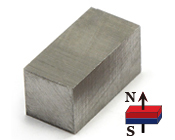
Engineering Reference • Material Selection, Metallurgy & Circuit Permeance
Engineering Guide to Alnico Permanent Magnets: Metallurgy, Magnetic Circuits & Thermal Stability
Commercialized in the 1930s, Alnico permanent magnets are iron-based alloys primarily composed of Aluminum (Al), Nickel (Ni), and Cobalt (Co), along with copper, titanium, and iron (Fe). Alnico represents one of the most mechanically and thermally resilient classes of magnetic materials ever developed. Although modern rare-earth alloys (such as Neodymium and Samarium Cobalt) provide higher energy products at ambient temperatures, Alnico remains the gold standard for continuous high-temperature service up to 1,000°F (538°C), possessing a Curie temperature of 1,580°F (860°C). Combined with high remanence (Br up to 12.8 kG), natural oxidation immunity, and the lowest reversible temperature coefficient of any commercial magnet, Alnico is indispensable for precision avionics, foundry equipment, automotive speedometers, and musical instruments.
| Grade & Process | Orientation | Remanence (Br) | Coercivity (Hcb) | Energy Product (BHmax) | Max Temp (Tmax) |
|---|---|---|---|---|---|
| Cast Alnico 2 | Isotropic | 7.5 kG (0.75 T) | 560 Oe (45 kA/m) | 1.7 MGOe | 840°F (450°C) |
| Cast Alnico 3 | Isotropic | 7.0 kG (0.70 T) | 480 Oe (38 kA/m) | 1.35 MGOe | 840°F (450°C) |
| Cast Alnico 5 | Anisotropic | 12.8 kG (1.28 T) | 640 Oe (51 kA/m) | 5.5 MGOe | 977°F (525°C) |
| Cast Alnico 8 | Anisotropic | 8.2 kG (0.82 T) | 1,650 Oe (131 kA/m) | 5.3 MGOe | 1,000°F (538°C) |
| Sintered Alnico 5 | Anisotropic | 10.9 kG (1.09 T) | 620 Oe (49 kA/m) | 3.9 MGOe | 977°F (525°C) |
| Sintered Alnico 8 | Anisotropic | 7.4 kG (0.74 T) | 1,500 Oe (119 kA/m) | 4.0 MGOe | 1,000°F (538°C) |
Manufacturing Processes: Cast Alnico vs. Powdered Sintered Alnico
Cast Alnico (Poured Sand/Shell Molds)
Molten alloy poured into sand molds or shell investment castings. Casting is the standard process for larger bars, heavy cylinders, and custom cross-sections. Cast Alnico yields the highest residual induction (Br) and maximum energy product (BHmax), but produces internal micro-porosity and brittle grain boundaries requiring centerless wet grinding.
Sintered Alnico (Powder Metallurgy)
Produced by pressing finely powdered raw metal constituents in rigid dies followed by high-vacuum sintering. Sintered Alnico provides superior mechanical fracture toughness, higher transverse rupture strength, and tighter as-sintered dimensional tolerances (±0.005"), making it ideal for micro-rotors and high-rpm sensor targets.
Thermal Physics: Lowest Reversible Temperature Coefficient in Magnetics
Where rare earth materials lose considerable magnetic force as heat climbs, Alnico displays near-zero thermal sensitivity. It possesses an industry-best reversible temperature coefficient of induction:
- Reversible Temperature Coefficient (α of Br): Only −0.02% per °C (−0.01% per °F). By comparison, Neodymium loses −0.11%/°C—meaning NdFeB loses over five times more field strength per degree of heating than Alnico.
- Curie Temperature (Tc): At 1,580°F (860°C), Alnico maintains internal domain orientation long after rare-earth magnets have completely decoupled.
- Continuous Service Threshold: Alnico 5 and 8 retain useful magnetic field output up to 977°F to 1,000°F (525°C – 538°C), making them standard for thermal treatment holding fixtures, furnace latches, and jet turbine tachometers.
Magnetic Circuit Design: Permeance Coefficient (Pc) & Self-Demagnetization
The defining engineering characteristic of Alnico is its low coercive force (Hc) paired with high remanence (Br). Because its intrinsic coercivity is relatively low (480 to 1,650 Oe, compared to >12,000 Oe for NdFeB), Alnico is highly sensitive to self-demagnetization caused by its own internal magnetic poles if designed in short geometric shapes.
The 5:1 Aspect Ratio Rule: In an open circuit without steel pole pieces, an Alnico cylinder or bar must maintain a Length-to-Diameter (L/D) ratio of at least 4:1 to 5:1 (operating at a Permeance Coefficient Pc ≥ 4.0). If cut into a thin disc (e.g., 1" diameter × 1/8" thick), its self-demagnetizing field will push the operating point below the knee of the B-H curve, permanently demagnetizing the part. When short aspect ratios are required, soft iron keeper plates or closed steel return paths are required.
Machining Constraints & Natural Corrosion Resistance
Alnico is an extremely hard and brittle metallic material (Rockwell Hardness 45–55 HRC, Vickers HV 500–600). It cannot be drilled, tapped, turned, or reamed with conventional high-speed steel (HSS) or carbide shop tooling. Machining is performed strictly by abrasive centerless grinding, precision wet surface grinding with aluminum oxide wheels, or electrical discharge machining (EDM). Holes, counterbores, and slots must be cast directly during initial mold pouring or wire-EDM cut in final assembly.
Unlike Neodymium, Alnico contains sufficient cobalt and nickel to develop a natural passivating surface oxide layer. Alnico magnets require no electroplating or protective coatings for ordinary industrial service, outdoor atmospheric exposure, or hot oil immersion. Plating (such as bright nickel or red enamel) is applied strictly for aesthetic identification or food-grade washdown sanitation.
Storage Protocol: Preventing Accidental Demagnetization
Keeper Plate Requirement: Storing Alnico magnets loose in bins or contacting like poles (North against North) will immediately induce partial demagnetization. Always store Alnico magnets in attracted pairs or with soft-iron keeper plates bridging the pole faces.
Post-Assembly Calibration: Because Alnico is easily calibrated, engineers frequently saturate the assembly with a capacitive discharge magnetizer and then deliberately "knock down" (calibrate) the field by 2–5% using a controlled AC demagnetizing field to guarantee absolute long-term stability in sensor circuits.
Looking for Alternative Alloys or Custom OEM Profiles?
If your application operates below 176°F (80°C) and requires maximum holding force per unit volume, explore our high-energy Neodymium Rare Earth Magnets (N35–N52). For continuous operating temperatures up to 572°F (300°C) that combine thermal survivability with high coercivity against demagnetization, view our Samarium Cobalt (SmCo) Magnets. For low-cost high-temperature latching up to 400°F, browse our Ceramic Ferrite Magnets. For custom wire-EDM slicing, centerless ground rod tolerances, or magnetized assemblies, submit your CAD drawings to our Custom Magnet Manufacturing division.
Join Our Mailing List for special offers!
Discover Magnet4Sale's latest industrial magnets, engineering insights, and exclusive offers. Get updates on advanced solutions and product innovations in our world of high-grade magnets. Subscribe for essential engineering-focused content!