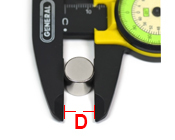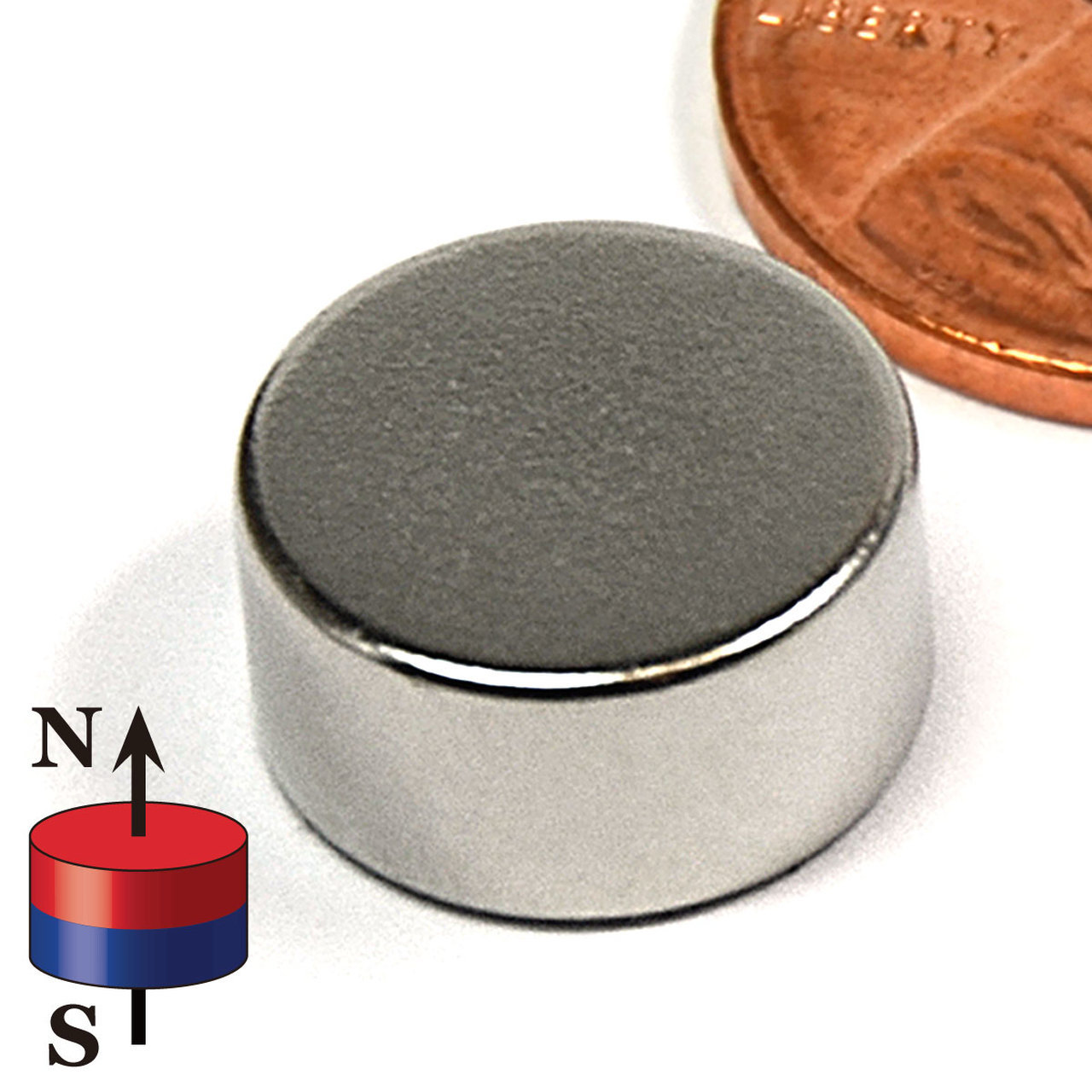
CMS Magnetics stocks an extensive inventory of precision-sintered neodymium disc magnets (NdFeB), engineered for high-holding-force applications where space is constrained. Featuring a round circular profile where diameter exceeds or equals thickness, our rare-earth discs deliver maximum perpendicular pull force per unit volume. Available in grades ranging from cost-effective N35 through ultra-high-energy N52 and N55, each magnet is coated with our standard industrial triple-layer Ni-Cu-Ni (Nickel-Copper-Nickel) plating for optimal corrosion and chip resistance.
Poles are located on the flat circular faces for maximum direct contact holding power.
From economical N35 (35 MGOe) up to maximum-strength N52 and N55 (55 MGOe).
Tight machining tolerances ensure repeatable flush-mounting in CNC pockets and jigs.
Multi-stage electroplating prevents raw alloy oxidation and premature edge chipping.
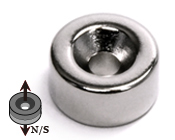
Looking for shapes other than discs? Explore our full catalog of high-strength Neodymium Magnets to shop blocks, rings, countersunk holes, and custom assemblies.
Neodymium disc magnets are the most ubiquitous permanent magnet geometry utilized across industrial automation, medical robotics, consumer electronics, and cabinetry. To ensure maximum retention and long-term durability in your assembly, evaluate the mechanical and electromagnetic factors below:
| Grade | Residual Flux Density (Br) | Max Energy Product (BHmax) | Max Operating Temp (Tmax) | Best Applied For |
|---|---|---|---|---|
| N35 | 11.7 – 12.1 kG | 33 – 36 MGOe | 80°C (176°F) | General holding, retail displays, light latches |
| N42 | 12.8 – 13.2 kG | 40 – 43 MGOe | 80°C (176°F) | Industry standard: optimal balance of cost vs. pull strength |
| N52 | 14.3 – 14.8 kG | 50 – 53 MGOe | 65°C – 80°C | Extreme holding force in micro and low-profile footprints |
| N55 | 14.9 – 15.3 kG | 53 – 56 MGOe | 60°C – 70°C | Peak theoretical saturation for aerospace and micro-sensing |
A common engineering trap is assuming a disc magnet will hold its full rated pull force when mounted vertically on a wall or steel frame. Rated pull force is measured under Case 1 conditions (direct perpendicular breakaway force against a polished, clean 1/2-inch thick low-carbon steel plate).
While both disc and cylinder magnets share circular profiles, the industry standard distinction is based on the aspect ratio:
• Disc Magnets: The diameter is greater than or equal to the thickness ($D \ge T$). Discs provide broad surface contact and high clamping force close to the steel surface.
• Cylinder & Rod Magnets: The length/thickness exceeds the diameter ($T > D$). Cylinders project an axial magnetic field deeper into surrounding air gaps, making them ideal for triggering Hall effect sensors and reed switches at greater distances. Browse our complete stock of Cylinder & Rod Magnets.
All standard neodymium disc magnets in this category are axially magnetized through the thickness (one circular face is North, and the opposite circular face is South). If your application requires magnetization across the diameter (side-to-side) for rotary encoders or magnetic fluid stirrers, browse our Diametrically Magnetized Magnets.
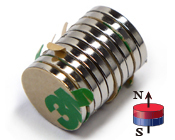
For permanent structural bonding, use two-part toughened epoxies (such as Loctite EA E-20HP or 3M DP420) or structural acrylic adhesives (Loctite AA 324 paired with SF 7387 activator). For peel-and-stick applications on paper, cardstock, or smooth plastics, explore our pre-applied Adhesive Backed Neodymium Discs with genuine 3M VHB tape.
No. Sintered neodymium is an extremely hard and brittle ceramic material. Drilling, sawing, or grinding with conventional workshop tools will cause the magnet to chip, break, or generate pyrophoric NdFeB dust that can ignite. Machining also damages the protective nickel plating, exposing raw neodymium to oxidation. If mechanical screw retention is required, order our pre-formed Countersunk Disc Magnets.
Stacking magnets increases pull force, but it does not double it. Pull force increases non-linearly with thickness due to magnetic saturation. For example, stacking two 1/8" thick discs provides roughly 50% to 75% more pull force than a single disc, effectively behaving like a single 1/4" thick magnet. Once the thickness exceeds approximately half the diameter, adding additional magnets provides diminishing returns.