Tel: 972-516-0692

Easy Return Policy
satisfaction guaranteed
satisfaction guaranteed
Premium Products
we guarantee our quality
we guarantee our quality
100% Safe Shopping
256 bit SSL encryption
256 bit SSL encryption
Shop By Category
Shop By Brand
Shop By Brand
Block & Bar Magnets
Planar High-Holding Sintered NdFeB
Neodymium Block & Bar Magnets (Rectangular Rare Earth Magnets)
CMS Magnetics stocks an extensive selection of sintered neodymium block and bar magnets (NdFeB), manufactured for high-shear linear fixtures, heavy industrial workholding, magnetic separators, and precision cabinet latches. With flat rectangular profiles that eliminate rotational slip, our rare-earth blocks provide broad surface contact and superior shear-load resistance compared to circular magnets. Available in grades from N35 through ultra-high-energy N52 and N55, each magnet is ground to precision dimensional tolerances (±0.05 mm) and protected with an industrial triple-layer Ni-Cu-Ni electrolytic coating.
Looking for mounting holes, waterproof coatings, or circular profiles? For direct bolt mounting, browse our Countersunk Blocks, or choose weatherproof Plastic Coated Blocks. For circular stock, view our Neodymium Discs and Ring Magnets, or return to our master Neodymium Magnets department to shop all available forms.
Anti-Twist Planar Fixturing
Rectangular edges prevent rotational alignment drift common with round disc and cylinder magnets.
Thickness Magnetization
Magnetized through the smallest dimension (thickness) to maximize active clamping surface area.
Precision Ground (±0.05 mm)
Strict mechanical tolerance control guarantees seamless slotting into CNC mill pockets and channels.
Standard Grade Coverage
Full inventory spectrum from high-value N35 up to maximum-saturation N52 and N55 rare-earth grades.



Engineering Guide: Specification & Magnetic Circuit Design for Neodymium Blocks
Rectangular block and bar magnets are the fundamental building blocks of industrial automation fixtures, linear Halbach arrays, eddy-current braking systems, and magnetic separation grates. Unlike symmetrical discs, rectangular magnets require careful attention to dimension labeling, axis of magnetization, and mechanical clamping physics.
Neodymium Block Grade Comparison (N35 to N55)
| Grade | Residual Induction (Br) | Energy Product (BHmax) | Max Operating Temp (Tmax) | Typical Engineering Application |
|---|---|---|---|---|
| N35 | 11.7 – 12.1 kG | 33 – 36 MGOe | 80°C (176°F) | Cost-effective fixturing, large separation plates, trade displays |
| N42 | 12.8 – 13.2 kG | 40 – 43 MGOe | 80°C (176°F) | Industry standard benchmark: ideal cost-to-pull force ratio |
| N52 | 14.3 – 14.8 kG | 50 – 53 MGOe | 65°C – 80°C | High-flux robotics, compact linear actuators, tight spaces |
| N55 | 14.9 – 15.3 kG | 53 – 56 MGOe | 60°C – 70°C | Peak commercial energy ceiling for aerospace and scientific research |
Standard Dimension Nomenclature: Length × Width × Thickness
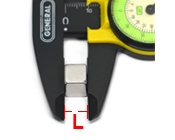
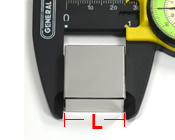
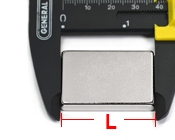
In precision magnet engineering, dimensions are universally stated as Length (L) × Width (W) × Thickness (T):
- Length & Width (L × W): Define the primary rectangular pole faces where the magnetic flux enters and exits.
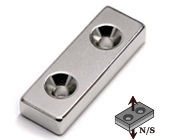
- Thickness (T): By industry convention, the last dimension listed is always the direction of magnetization. Unless explicitly labeled otherwise, our stock blocks are magnetized through the thickness, meaning the North and South poles reside on the two broad flat $L \times W$ faces.
- Block vs. Bar Terminology: While both are rectangular prisms, "bars" generally refer to elongated geometries where the Length is at least three times the Width ($L \ge 3W$). For square cross-section blocks with equal sides ($L = W = T$), explore our dedicated Cube Magnets.
Vertical Shear Slide Physics & Slip Resistance
Published pull forces indicate direct perpendicular breakaway strength (Case 1) tested on flat, ground 1/2-inch steel. When mounting a neodymium bar vertically to hold shear loads:
- Smooth Plating Friction: Electrolytic nickel-plated NdFeB has a low coefficient of friction against smooth structural steel ($\mu \approx 0.15\text{--}0.20$). A vertical block magnet will begin sliding downward under approximately 15% to 20% of its rated perpendicular pull force.
- Mechanical Recessing: For maximum shear retention in tooling fixtures, machine a shallow 0.030" to 0.060" pocket into your backing plate to physically capture the magnet edges.
- Friction & Surface Protection: If pocketing is not possible, pair your assembly with high-friction Plastic Coated Blocks or mate them directly to non-magnetic Steel Magnet Strikers.
Frequently Asked Questions
Can neodymium block magnets be cut, drilled, or machined to custom lengths?
No. Sintered neodymium-iron-boron is an exceptionally hard and brittle alloy produced via powder metallurgy. Drilling or cutting with conventional machine tools will fracture the material, produce pyrophoric dust, and destroy the protective plating, causing rapid oxidation. For screw attachment, select pre-machined Countersunk Blocks or request custom OEM production runs.
How do I bond neodymium blocks into aluminum, steel, or 3D-printed channels?
For permanent structural bonding, use toughened two-part epoxies (such as 3M DP420 or Loctite EA E-20HP) or structural acrylic adhesives (such as Loctite AA 324 with SF 7387 activator). To ensure optimal bondline thickness (0.003" to 0.005") and avoid dry squeeze-out under magnetic clamping pressure, incorporate fine glass spacer beads into the adhesive matrix.
What is the difference between a block magnet and a channel magnet?
A block magnet is raw sintered NdFeB with exposed magnetic poles on both top and bottom faces. A Channel Magnet encases a neodymium block inside a U-shaped steel channel. The steel redirects the flux from the back pole to the front, drastically multiplying direct clamping force on contact while shielding the brittle magnet edges from mechanical impacts.
How should large neodymium bar magnets be safely separated?
Never attempt to pull strong neodymium blocks straight apart by hand. Doing so risks violent snapping, shattered magnets, and severe pinch injuries. Instead, slide or shear the top magnet laterally off the stack across a clean, non-magnetic wooden or plastic tabletop edge while keeping a firm, controlled grip.
Join Our Mailing List for special offers!
Discover Magnet4Sale's latest industrial magnets, engineering insights, and exclusive offers. Get updates on advanced solutions and product innovations in our world of high-grade magnets. Subscribe for essential engineering-focused content!