Tel: 972-516-0692

Easy Return Policy
satisfaction guaranteed
satisfaction guaranteed
Premium Products
we guarantee our quality
we guarantee our quality
100% Safe Shopping
256 bit SSL encryption
256 bit SSL encryption
Shop By Category
Shop By Brand
Shop By Brand
Cup & Pot Magnets
Steel-Cased Magnetic Assemblies & Workholding Bases
Cup & Pot Magnets (Magnetic Mounting Bases & Channel Assemblies)
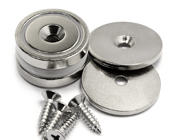
CMS Magnetics engineers high-performance cup and pot magnets (also known as magnetic mounting bases and round-base assemblies) designed for extreme clamping force, fixturing, and equipment retrieval. By encasing a permanent magnetic core inside a plated mild-steel cup or U-channel, the steel shell acts as a flux conductor—redirecting and focusing the rear and side magnetic field onto a single active contact plane. This mechanical shunt multiplies direct perpendicular pull force up to 4x to 6x that of an unshielded magnet of identical size, while physically protecting the brittle neodymium, ceramic, or AlNiCo core from mechanical impact and shattering.
Looking for raw, uncased permanent magnets? If your assembly requires unshielded magnets that emit magnetic field from both poles, explore our raw Neodymium Disc Magnets, Block & Bar Magnets, or Ring Magnets. For pairing with non-magnetic surfaces, see our Steel Magnet Strikers.
Focused Flux Circuit
Mild steel casing redirects both poles to a single plane, massively amplifying surface pull force.
Impact & Chip Protection
Steel wall absorbs direct mechanical shock, preventing brittle magnetic cores from shattering.
Standard Hardware Threading
Integrated countersunk holes, male studs, and female threaded collars match standard bolts.
Multi-Alloy Options
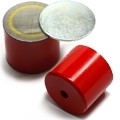
Precision Neodymium for max holding power, Ceramic for outdoor weather, and AlNiCo for high heat.

Engineering Guide: Cup & Pot Magnet Physics & Mechanical Mounting Design
Cup magnets (pot magnets) are composite assemblies engineered to overcome the two primary drawbacks of raw sintered permanent magnets: physical brittleness and unshielded multidirectional flux leakage. Selecting the optimal mounting base requires matching the core magnetic material to your thermal, environmental, and mechanical load specifications.
Magnetic Base Comparison: Neodymium vs. Ceramic vs. AlNiCo
| Feature / Metric | Neodymium Cup Magnets | Ceramic (Ferrite) Cup Magnets | AlNiCo Pot Magnets |
|---|---|---|---|
| Relative Holding Force | Maximum (5x to 10x Ceramic) | Moderate clamping strength | Moderate; stable over long air gaps |
| Max Operating Temperature | 80°C (176°F) standard; up to 150°C | 250°C (482°F) | 450°C to 500°C (932°F) |
| Corrosion & Weathering | Triple Ni-Cu-Ni plating (dry/indoor preferred) | Naturally rust-proof ceramic oxide | High resistance to industrial solvents |
| Cost per Unit Volume | Higher (premium rare-earth alloy) | Most Economical (High Volume) | Moderate to high specialty cost |
| Primary Mechanical Uses | Heavy industrial clamping, CNC jigs, antennas | Outdoor signage, vehicle gates, retail fixtures | High-heat furnace fixturing, foundry tooling |
Physics of the Steel Cup: Why Cased Assemblies Outperform Raw Magnets
When a permanent magnet is suspended in air, magnetic flux radiates outward in all directions from both poles. In a cup or pot assembly, the magnet is permanently seated inside a low-carbon steel cup:
- Magnetic Shunting & Flux Concentration: The high magnetic permeability of the steel shell channels flux lines from the rear pole forward toward the open rim. This creates a tightly closed magnetic circuit directly at the contact surface, concentrating maximum flux density into the mating steel substrate.
- Air Gap Sensitivity: Because the flux path between the central magnetic face and outer steel rim is short and compact, cup magnets produce extraordinary holding strength on direct flush contact, but lose strength more rapidly over large air gaps compared to raw, unshielded blocks or discs.
- Zero Rear Attraction: The steel backing acts as a magnetic shield, significantly attenuating stray magnetic fields behind the cup. This prevents unwanted metal chips or tools from adhering to the back of the assembly.
Mounting Mechanics: Perpendicular Pull vs. Vertical Shear Slide
Published holding forces represent direct perpendicular breakaway pull (Case 1) tested on flat, clean, 1/2-inch thick low-carbon steel. When mounting a cup magnet vertically on a wall or equipment chassis:
- Smooth Plating Friction: Because nickel-plated steel has a low friction coefficient against steel (μ ≈ 0.15 – 0.20), a vertical cup magnet will begin sliding downward under approximately 15% to 20% of its rated perpendicular pull force.
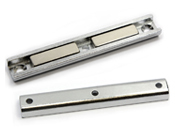
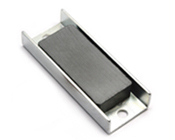
- Linear Anti-Twist Fixturing: For narrow metal channels and door latches requiring rotational stability, utilize our rectangular Neodymium Channel Magnets or Ceramic Channel Magnets.
- Mating Strike Plates: If securing to wood, drywall, or non-magnetic aluminum, pair with our pre-drilled Steel Magnet Strikers.
Frequently Asked Questions
What is the mechanical difference between a cup magnet and a raw countersunk magnet?
A raw countersunk magnet is an unencased piece of sintered NdFeB that is brittle and emits magnetic flux in all directions. A cup magnet encloses the magnet inside a protective steel cup. The steel casing prevents edge impact chipping and focuses the magnetic flux forward, producing substantially higher clamping force on contact.
Which mounting style should I select for my assembly?
Choose Countersunk Hole Cups for flush screw mounting into walls and fixtures. Choose Male Threaded Stud Cups to screw directly into tapped equipment holes or attach with lock nuts. Choose Female Threaded Stud or Internal Threaded Hole Cups to receive standard machine bolts, hooks, or eye bolts.
Why does steel thickness matter when attaching cup magnets?
To achieve 100% of the published pull rating, a cup magnet requires a steel surface thick enough to absorb all magnetic flux lines without magnetic saturation (typically 1/4" to 1/2" thick clean low-carbon steel). When attached to thin sheet metal (such as 20-gauge steel cabinet panels), the metal saturates quickly, reducing effective clamping force by 50% or more.
Can neodymium cup magnets be used outdoors?
Standard nickel-plated neodymium cup magnets are suitable for indoor and dry industrial environments. For outdoor, marine, or washdown environments, choose Ceramic Cup Magnets (which are naturally rust-proof) or pair neodymium assemblies with protective polyurethane or rubber boots.
Join Our Mailing List for special offers!
Discover Magnet4Sale's latest industrial magnets, engineering insights, and exclusive offers. Get updates on advanced solutions and product innovations in our world of high-grade magnets. Subscribe for essential engineering-focused content!